
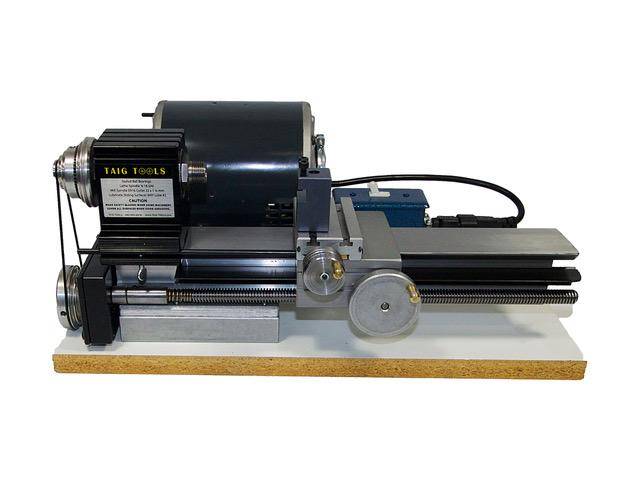
TAIG Tools (Chandler, Arizona) offers several Micro Lathe II versions, and the best choice depends on whether you need a motor, power feed, or specific spindle options like ER16 or 5C.
Understanding the differences between models like the L1017, M1015, M1015ER, and M1015-5C is key to selecting the right precision benchtop machine for your projects.
Key Takeaways
- The TAIG L1017 Micro Lathe II is a motor-less option, suitable for those who already have a motor or prefer a custom setup.
- The M1015 Micro Lathe II includes a motor and power feed, offering a complete solution for general turning tasks.
- For enhanced tool holding, the M1015ER Micro Lathe II features an ER16 spindle, providing greater versatility with collets.
- The M1015-5C Micro Lathe II, with its 5C spindle, is ideal for precision work requiring robust and accurate workpiece clamping.
- All TAIG Micro Lathe II models are built with durable steel construction and heat-treated alloy-steel components for machining various materials.
When investing in a precision benchtop lathe, understanding the specific features and capabilities of each model is crucial. TAIG Tools, a family-run US manufacturer based in Chandler, Arizona, has been producing micro machine tools for decades, building them with an aerospace manufacturing background. Their Micro Lathe II series is designed for a range of users, from hobby machinists and jewelers to small shops and educational institutions. These machines are known for their ability to cut steel, aluminum, brass, wood, and plastic, making them versatile tools for many applications.
What are the Core Differences Between TAIG Micro Lathe II Models?
The primary distinctions among the TAIG Micro Lathe II models revolve around their included components and spindle configurations. These differences directly impact the machine's functionality, ease of use, and suitability for various precision turning tasks. Buyers should consider their existing equipment, desired level of automation, and specific workholding requirements when making a selection.
The base model, the L1017, is designed for users who prefer to supply their own motor or integrate the lathe into a custom drive system. Moving up, the M1015 provides a complete, ready-to-run package with an included motor and power feed. The M1015ER and M1015-5C models then introduce specialized spindle options, catering to users who require the enhanced gripping capabilities of ER16 collets or the robust, precise clamping of 5C collets. Each model maintains the core TAIG quality of steel construction and heat-treated alloy-steel components.
Which Micro Lathe II is Best for Beginners or Those with Existing Motors?
For individuals just starting in machining or those who already possess a suitable motor, the TAIG L1017 Micro Lathe II is an excellent entry point. Priced at $245.25, this model provides the fundamental lathe bed, headstock, tailstock, and carriage without a motor or power feed. This allows users to integrate their preferred motor, which can be a cost-effective solution if they have one readily available. It's also a good option for educational settings where custom drive systems might be part of the curriculum.
However, it's important to understand that the L1017 requires additional investment in a motor and drive system to become operational. This means a new user will need to source a motor, pulley, and belt, and then mount them appropriately. While this offers flexibility, it also adds a layer of complexity and time to the initial setup. For those who prioritize a complete, ready-to-run package, other models might be more suitable.
The L1017 is ideal for hands-on learners who enjoy customizing their tools and for those who have specific motor requirements not met by standard offerings. You can find more details on the L1017 Micro Lathe II.
When is the M1015 Micro Lathe II the Right Choice?
The TAIG M1015 Micro Lathe II, priced at $520, is designed for users seeking a complete, ready-to-operate benchtop lathe with an included motor and power feed. This model eliminates the need to source and install a separate motor, making it a convenient option for hobbyists, small shops, and educational institutions that need a functional machine out of the box. The power feed feature is particularly beneficial for achieving consistent surface finishes on longer workpieces, reducing manual effort and improving part quality.
The M1015 is a versatile machine capable of handling a wide range of materials, including steel, aluminum, brass, wood, and plastic. Its robust construction, featuring oversized spindle ball bearings and heat-treated alloy-steel components, ensures durability and precision for various turning operations. While it offers a complete solution, users should be aware that the standard spindle setup may not offer the same collet versatility as the ER16 or 5C options on other models. However, for general turning, facing, and drilling operations, the M1015 provides a solid foundation.
Explore the M1015 Micro Lathe II for a comprehensive solution.
What are the Advantages of an ER16 Spindle on the M1015ER?
The TAIG M1015ER Micro Lathe II, available for $575, stands out due to its integrated ER16 spindle. This feature is a significant upgrade for users who require enhanced tool holding capabilities and greater versatility with collets. ER16 collets offer a wide gripping range, allowing for secure clamping of various stock sizes and tooling, which is crucial for precision work and reducing setup time. This spindle type is particularly beneficial for jewelers, clockmakers, and prototypers who frequently work with small, delicate parts and require precise concentricity.
The ER16 spindle provides superior gripping power compared to standard chucks for certain applications, minimizing workpiece runout and improving machining accuracy. While the M1015ER shares the motor and power feed benefits of the standard M1015, the ER16 spindle makes it a more specialized tool for those who prioritize collet work. However, users should note that ER16 collets are a specific type of workholding, and for very large diameter work, a traditional three or four-jaw chuck might still be necessary. The M1015ER is a strong choice for those looking to expand their workholding options and achieve higher precision with smaller components.
Learn more about the M1015ER Micro Lathe II.
Why Choose the M1015-5C Micro Lathe II with a 5C Spindle?
For the highest levels of precision and rigidity in workpiece clamping, the TAIG M1015-5C Micro Lathe II, priced at $990, is the premium option. This model incorporates a 5C spindle, which is a widely recognized standard in precision machining for its exceptional gripping force and accuracy. 5C collets offer superior concentricity and holding power, making this lathe ideal for demanding applications where minimal runout is critical, such as in tool and die making, instrument manufacturing, and high-precision prototyping.
The 5C spindle allows for quick and repeatable setup of workpieces, which can significantly improve efficiency in production environments or when making multiple identical parts. While the investment is higher, the M1015-5C delivers stability and accuracy for its size. This model is particularly suited for experienced machinists, small machine shops, and educational institutions focused on advanced machining techniques. It's important to consider that 5C collets can be more expensive than other types and have a more limited gripping range per collet, requiring a larger set for full versatility.
However, for critical precision work, the benefits of a 5C spindle often outweigh these considerations. Discover the M1015-5C Micro Lathe II.
How Do the TAIG Micro Lathe II Models Compare?
Understanding the direct comparisons between the TAIG Micro Lathe II models can help clarify which features align best with your specific machining needs. Each model builds upon the foundational design, adding capabilities that cater to different user requirements and budgets. This table provides a concise overview of the key differences, allowing for a quick assessment of their respective strengths.
| Feature | L1017 Micro Lathe II | M1015 Micro Lathe II | M1015ER Micro Lathe II | M1015-5C Micro Lathe II |
|---|---|---|---|---|
| Price | $245.25 | $520 | $575 | $990 |
| Motor Included | No | Yes | Yes | Yes |
| Power Feed | No | Yes | Yes | Yes |
| Spindle Type | Standard | Standard | ER16 | 5C |
| Ideal User | Custom builds, existing motor owners | General turning, hobbyists | Precision collet work, small parts | High-precision, rigid clamping |
| Trade-offs | Requires separate motor/drive | Standard spindle, less collet versatility | ER16 collets needed | Higher cost, 5C collets needed |
This comparison highlights that while all models share the core TAIG Micro Lathe II design, the inclusion of a motor, power feed, and specialized spindle types significantly alters their application and value proposition. The choice ultimately depends on your budget, the types of projects you undertake, and your specific requirements for workholding and automation.
What Upgrades Are Available for TAIG Micro Lathes?
TAIG Micro Lathes are designed with an upgrade path in mind, allowing owners to enhance their machine's capabilities over time. For existing TAIG owners, or those purchasing a base model, several key upgrades can significantly improve functionality and versatility. These upgrades cater to different aspects of machining, from workholding to overall machine performance.
Consider these common upgrades for your TAIG Micro Lathe:
- 5C or ER16 Headstock: If you start with a standard spindle, upgrading to a 5C or ER16 headstock (like those found on the M1015-5C or M1015ER) can dramatically improve workholding precision and versatility. This is a crucial upgrade for anyone doing high-precision work with small parts.
- Chucks: While lathes often come with a basic chuck, investing in higher-quality 3-jaw or 4-jaw chucks can enhance gripping power and accuracy for various workpiece shapes.
- Tool Posts: Upgrading to a quick-change tool post system can save significant time during tool changes and improve repeatability. This is especially beneficial for projects requiring multiple tools.
- Live Centers and Drill Chucks for Tailstock: These accessories expand the functionality of the tailstock for drilling operations and supporting longer workpieces.
These upgrades allow users to tailor their TAIG Micro Lathe II to evolving project needs, ensuring the machine remains a valuable asset in their workshop for years to come. Many parts and accessories can be found on the TAIG Tools Parts & Accessories page.
How Does a Micro Lathe II Compare to a Micro Mill?
While both the TAIG Micro Lathe II and TAIG Micro Mills are precision benchtop machine tools, they serve fundamentally different purposes in a workshop. A micro lathe, like the Micro Lathe II series, is primarily designed for turning operations, where a workpiece is rotated against a cutting tool to create cylindrical or conical shapes. This is ideal for making shafts, pins, bushings, and other round components. The machine excels at concentricity and producing smooth, rotational surfaces.
In contrast, a micro mill, such as the TAIG 5023DSLS CNC Micro Mill or the 2023ER Micro Mill, is used for milling operations, where a rotating cutting tool is moved across a stationary workpiece to remove material and create flat surfaces, slots, holes, and complex contours. Mills are essential for creating square, rectangular, or irregular shapes, and for drilling precise holes at specific locations. While some limited milling can be done on a lathe with specialized attachments, a dedicated mill offers far greater rigidity, accuracy, and versatility for such tasks. Choosing between a lathe and a mill, or investing in both, depends entirely on the types of parts you intend to create.
For more on mills, consider reading about Choosing the Best Desktop CNC Mill for a Small Shop.
What Materials Can TAIG Micro Lathes Machine?
TAIG Micro Lathes are designed to be versatile, capable of machining a wide array of materials commonly encountered in hobbyist, prototyping, and small shop environments. The robust construction, featuring steel components and heat-treated alloy steel parts, contributes to their ability to handle both soft and moderately hard materials effectively. This versatility makes them suitable for a broad spectrum of projects, from intricate jewelry pieces to functional mechanical components.
Common materials that can be machined on a TAIG Micro Lathe include:
- Metals: Aluminum, brass, and mild steel are routinely machined. For harder steels, appropriate cutting tools and slower speeds are necessary to prevent tool wear and ensure a good finish.
- Plastics: Various plastics, such as Delrin, nylon, acrylic, and ABS, can be easily turned on a TAIG lathe, often resulting in very smooth finishes.
- Wood: Soft and hardwoods can also be machined, though specific tooling designed for wood turning may yield better results and finishes.
The key to successfully machining different materials lies in selecting the correct cutting tools, spindle speeds, and feed rates. For harder materials, carbide tooling is often recommended, while high-speed steel (HSS) tools are generally sufficient for softer metals, plastics, and wood. Always ensure your cutting tools are sharp and properly ground for the material you are working with to achieve optimal results and extend tool life. For general guidance on material properties and machining, resources like the ASM International provide valuable information.
Frequently Asked Questions
What does "power feed" mean on a micro lathe?
Power feed on a micro lathe refers to an automated mechanism that moves the cutting tool along the workpiece at a consistent rate. This feature helps achieve smoother surface finishes and more uniform cuts, especially on longer parts, by eliminating inconsistencies that can arise from manual feeding. It reduces operator fatigue and improves the overall quality of turned components.
Can I upgrade a standard TAIG Micro Lathe II to have an ER16 or 5C spindle later?
Yes, TAIG Tools designs its machines with modularity in mind, allowing for upgrades. You can typically purchase an ER16 or 5C headstock assembly separately and install it on your existing Micro Lathe II. This provides a flexible upgrade path, enabling you to enhance your machine's workholding capabilities as your needs or budget evolve.
Are TAIG Micro Lathes suitable for production work?
TAIG Micro Lathes are primarily designed for precision benchtop work, prototyping, hobby use, and educational purposes. While they are robust and precise, their small work envelope and manual or semi-automated nature mean they are generally not intended for high-volume, continuous production environments. They excel in situations requiring high precision on small parts rather than rapid mass production.
What kind of motor is included with the M1015 series lathes?
The M1015 series lathes, including the M1015, M1015ER, and M1015-5C, typically come with a standard 1/4 HP motor. This motor is sufficient for driving the lathe through a wide range of materials and operations for which the machine is designed. Users should note that while powerful for its size, it has limitations compared to larger industrial motors.
What is the warranty on TAIG Micro Lathe II components?
TAIG Tools offers a 2-year factory warranty on mill components and accessories. This commitment to quality extends across their product line. For precise warranty details on specific lathe components, it is always best to consult the product page or contact TAIG Tools directly.
To explore the full range of options and find the perfect machine for your needs, visit the TAIG Micro Lathe II category page.