
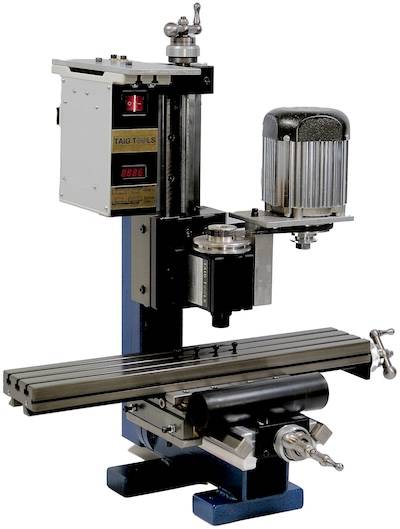
For knife makers seeking precision and versatility in their workshop, TAIG Tools (Chandler, Arizona) offers a range of American-made benchtop micro mills and lathes. These machines are well-suited for tasks like shaping handles, profiling blades, and creating custom components from various materials.
Key Takeaways
- TAIG Tools micro mills and lathes are built by machinists with an aerospace manufacturing background, ensuring precision for knife making.
- These machines can effectively cut steel, aluminum, brass, wood, and plastic, covering common materials used in knife construction.
- TAIG offers both manual and CNC-ready options, allowing knife makers to choose based on their skill level and automation needs.
- The compact size and robust construction of TAIG machines make them ideal for small shops, hobbyists, and educational settings.
- An upgrade path exists from manual to full CNC, providing flexibility as a knife maker's needs evolve.
Knife making involves intricate work, often requiring precise material removal and shaping. Whether you're working on handle scales, bolsters, guards, or even custom blade profiles, a reliable machine tool is essential. TAIG Tools has been manufacturing precision desktop machine tools for decades, providing solutions for artisans, hobbyists, and small machine shops. Their machines are known for their steel construction, oversized spindle ball bearings, and heat-treated alloy steel parts, making them capable of handling tough materials.
What materials can TAIG machines handle for knife making?
TAIG micro mills and lathes are designed to machine a wide array of materials commonly used in knife making. This includes various types of steel, such as stainless and carbon steels for blades, as well as aluminum and brass for bolsters, guards, and pins. Beyond metals, these machines can also precisely cut wood and plastic, which are frequently used for handle materials. The robust construction, featuring oversize spindle ball bearings and heat-treated alloy-steel components, ensures that the machines maintain accuracy and rigidity when working with these diverse materials.
This versatility allows knife makers to tackle almost any component of a custom knife with a single machine.
Which TAIG micro mill is best for manual knife making tasks?
For knife makers who prefer a hands-on approach or are just starting with machining, the 2023ER Micro Mill is an excellent choice. Priced at $1,350, this manual leadscrew micro mill offers precise control for detailed work. It features an ER16 spindle, allowing for a wide range of tooling options, which is beneficial for various milling operations on knife components. While it requires manual operation for all axes, this can be an advantage for learning fundamental machining skills and for intricate, one-off parts where direct tactile feedback is preferred.
It's a solid foundation for any knife maker's workshop, providing the capability to machine steel, aluminum, and other materials with accuracy.
When should a knife maker consider a CNC micro mill?
A CNC micro mill becomes a significant asset for knife makers looking to increase repeatability, precision, and efficiency, especially for complex or batch production tasks. The 5023DSLS CNC Micro Mill, priced at $3,795, is a prime example of a machine that can transform a knife maker's workflow. This full CNC mill features closed-loop DSLS (Digital Sync Lock Servo) control, offering high accuracy and the ability to execute intricate designs repeatedly. For tasks like engraving custom logos, precise profiling of handle scales, or creating complex jig components, a CNC mill can save considerable time and ensure consistent results.
While it requires learning CAD/CAM software, the investment pays off in the ability to produce identical parts with minimal manual intervention.
What are the trade-offs between manual and CNC machines for knife making?
Choosing between a manual and a CNC machine involves considering your specific needs, budget, and willingness to learn new skills. Manual machines, like the 2023ER Micro Mill, are generally more affordable and offer direct control, which can be great for prototyping and learning. However, they require constant operator attention and can be less consistent for repetitive tasks. CNC machines, such as the 5023DSLS CNC Micro Mill, offer superior repeatability and can handle complex geometries automatically once programmed.
The trade-off is a higher initial cost and a steeper learning curve for software and machine setup.
Here's a comparison of key factors:
| Feature | TAIG 2023ER Micro Mill (Manual) | TAIG 5023DSLS CNC Micro Mill (Full CNC) |
|---|---|---|
| Price | $1,350 | $3,795 |
| Control | Manual leadscrew operation | Full CNC with closed-loop DSLS control |
| Complexity | Simpler to operate, direct physical interaction | Requires CAD/CAM software knowledge and setup |
| Repeatability | Dependent on operator skill | High, consistent for batch production |
| Ideal For | Prototyping, learning, one-off custom parts, small batches | Complex designs, high-volume consistency, intricate engraving |
| Upgrade Path | Can be upgraded to CNC-ready with kits | Ready for advanced automation and complex machining |
| Learning Curve | Focus on manual machining techniques | Focus on software, G-code, and machine calibration |
For knife makers, the choice often comes down to the volume of work and the complexity of designs. A manual mill is excellent for unique, handcrafted pieces, while a CNC mill excels at producing consistent batches of custom components or intricate patterns.
How can a micro lathe benefit a knife maker's workshop?
A micro lathe is invaluable for knife makers, particularly for creating and refining cylindrical components like handle pins, bolsters, and custom hardware. The 3029 Manual Turn Lathe, priced at $1,475, offers precision turning capabilities for various materials. This machine allows for precise diameter reduction, threading, and facing operations on metal or composite stock, ensuring a perfect fit for handle components. For example, creating custom-fit pins or shaping unique bolster designs is significantly easier and more accurate on a lathe than with hand tools.
The ability to hold tight tolerances on turned parts contributes to the overall fit and finish of a high-quality knife.
For those considering more advanced lathe capabilities, TAIG also offers the 4029CREXT CNC Ready Lathe and the 4029 DSLS Full CNC Lathe. The CNC-ready option provides a path to automation, allowing for future upgrades as your skills and needs evolve. A full CNC lathe, like the 4029 DSLS, offers the ultimate in precision and repeatability for complex turning operations, ideal for batch production of custom hardware or intricate handle components.
What upgrades are available for TAIG machines to enhance knife making?
TAIG Tools offers a variety of parts and accessories to enhance the functionality of their micro mills and lathes, catering to the specific needs of knife makers. For micro mills, common upgrades include different vises for securing workpieces, such as the 1225 Milling Vice for rigid clamping. Upgrading to ER16 collets provides greater gripping power and accuracy for end mills and drills, which is crucial for precise material removal. For those with manual mills, a CNC-ready conversion kit can be a significant upgrade, allowing for the integration of stepper motors and control systems to transition towards automated machining.
For micro lathes, a popular upgrade is the 5C or ER16 headstock, which allows for the use of precision collets for holding round stock more accurately than a standard chuck. This is particularly useful for turning small, delicate components like pins or custom fasteners. Various chucks, including 3-jaw and 4-jaw options, are also available to accommodate different workpiece shapes and sizes. Upgrading to a quick-change tool post can significantly reduce setup time when switching between turning, facing, and threading operations.
These upgrades allow knife makers to tailor their TAIG machines to their evolving needs and specific project requirements, ensuring maximum versatility and precision.
How do TAIG machines compare to larger industrial machines for knife making?
TAIG Tools machines are precision benchtop tools, designed for smaller work envelopes and detailed tasks, making them distinct from larger industrial machines. While industrial machines offer greater power, rigidity, and larger travel distances, they also come with significantly higher costs, larger footprints, and greater power requirements, often necessitating dedicated three-phase power. For a knife maker, who typically works with smaller stock and requires high precision on intricate parts rather than heavy material removal on large components, a TAIG micro mill or lathe provides an ideal balance.
The compact size of TAIG machines means they fit easily into home workshops, small studios, or educational settings without requiring extensive space or infrastructure. Their ability to machine steel, aluminum, brass, wood, and plastic with accuracy makes them perfectly suited for the scale of knife making. While they may not be suitable for high-volume industrial production of large parts, their precision and versatility for small-scale, detailed work make them a cost-effective and practical solution for artisans and small businesses. The focus is on precision and control for smaller workpieces, which aligns perfectly with the demands of custom knife making.
For further insights into machine tool safety, resources like the Occupational Safety and Health Administration (OSHA) provide valuable guidelines.
What should a knife maker consider before purchasing a TAIG machine?
Before investing in a TAIG micro mill or lathe, knife makers should carefully assess their specific needs, skill level, and workshop space. Consider the types of knives you primarily make and the materials you frequently use. If your work involves intricate handle designs, precise bolster fitting, or custom hardware, a machine tool will be highly beneficial. Evaluate whether a manual machine meets your current needs or if the repeatability and automation of a CNC machine would be more advantageous for your production goals.
It's also important to consider the learning curve associated with operating a machine tool, especially a CNC model which requires understanding CAD/CAM software. While TAIG machines are designed for ease of use, mastering precision machining takes practice and dedication. Finally, ensure you have adequate space in your workshop for the machine, along with proper ventilation and safety equipment. TAIG Tools provides a 2-year factory warranty on mill components and accessories, and a 14-day return policy, offering peace of mind with your purchase.
Frequently Asked Questions
What is the typical learning curve for operating a TAIG micro mill for knife making?
The learning curve for a TAIG micro mill depends on your prior machining experience. Manual mills are relatively straightforward to learn, focusing on hand-eye coordination and understanding cutting parameters. CNC mills, however, require learning CAD/CAM software for design and toolpath generation, which can take more time and practice to master.
Can TAIG machines be used for engraving on knife blades or handles?
Yes, TAIG micro mills, especially the CNC models like the 5023DSLS CNC Micro Mill, are well-suited for engraving intricate designs, logos, or serial numbers on knife blades, bolsters, and handle materials. The precision of CNC control allows for highly detailed and repeatable engraving work.
Are TAIG machines suitable for beginners in knife making?
TAIG machines are suitable for beginners, particularly the manual models, as they provide a hands-on introduction to precision machining. They are robust and forgiving, allowing new users to develop skills in milling and turning. Many educational institutions and makerspaces use TAIG machines for this very reason.
What kind of maintenance do TAIG machines require?
TAIG machines require regular cleaning to remove chips and debris, lubrication of leadscrews and moving parts, and occasional adjustment of gibs to maintain accuracy. Following the manufacturer's recommendations for maintenance ensures long-term performance and precision, which is crucial for knife making.
Can I upgrade a manual TAIG mill to CNC later?
Yes, many TAIG manual micro mills, including the 2023ER Micro Mill, can be upgraded to CNC-ready or full CNC later with conversion kits. This provides a flexible path for knife makers to start with a manual machine and transition to automation as their skills and production needs evolve.
For knife makers ready to explore the precision and versatility of automated machining, consider the range of CNC Micro Mills offered by TAIG Tools.