
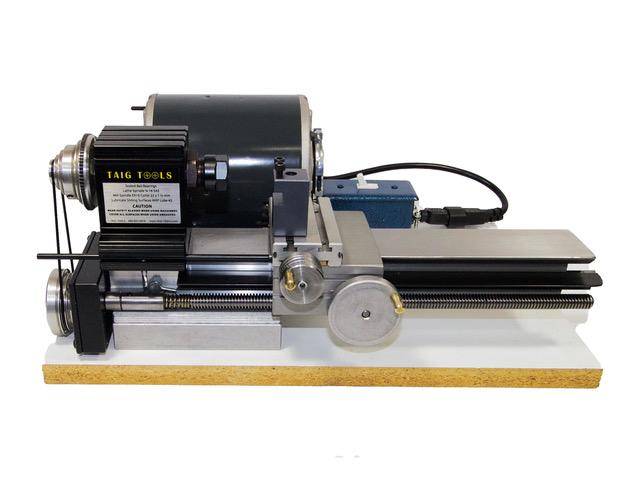
A good micro lathe for jewelry or model making needs precision and versatility for small, intricate parts, and TAIG Tools (Chandler, Arizona) offers American-made micro lathes designed for this exact purpose.
These machines provide the accuracy required to work with various materials, from precious metals to plastics, making them suitable for artisans, hobbyists, and small prototypers.
Key Takeaways
- TAIG Tools micro lathes are built in Chandler, Arizona, offering precision for delicate jewelry and model making tasks.
- The M1015ER Micro Lathe II is an excellent entry-level option for those needing a compact, versatile machine for small projects.
- For increased rigidity and workholding capacity, the M1017-5C Micro Lathe II with its 5C collet headstock is a significant upgrade.
- Starter Set #3 provides a comprehensive package for new users, including essential accessories to begin machining immediately.
- TAIG lathes are designed to machine steel, aluminum, brass, wood, and plastic, accommodating a wide range of materials common in jewelry and model making.
Understanding Micro Lathes for Precision Craftsmanship
Jewelry and model making often demand exceptional precision, working with small components and fine details. A micro lathe is a specialized machine tool designed for these tasks, offering the ability to turn, face, drill, and thread miniature parts with high accuracy. Unlike larger industrial lathes, micro lathes are compact, making them suitable for workshops with limited space, and are typically easier for hobbyists and educators to learn and operate. The choice of a micro lathe depends on the specific materials, part sizes, and desired level of automation, from manual operation to CNC capabilities.
What Makes a Micro Lathe Suitable for Jewelry and Model Making?
For jewelry and model making, a micro lathe must offer specific features to handle delicate materials and intricate designs. Key considerations include spindle accuracy, the ability to hold small workpieces securely, and the capacity to work with various materials like precious metals, plastics, and softer woods. The machine's construction, including its bearings and leadscrews, directly impacts the finish quality and dimensional accuracy of the parts produced. A robust, stable platform minimizes vibration, which is critical when machining fine details.
TAIG Tools micro lathes are built with oversized spindle ball bearings and heat-treated alloy-steel components, contributing to their precision and durability. This construction allows them to machine materials such as steel, aluminum, brass, wood, and plastic, which are commonly used in jewelry and model making projects. The ability to work with a diverse range of materials without compromising accuracy is a significant advantage for artisans and model builders who frequently switch between different project requirements. The National Institute of Standards and Technology (NIST) emphasizes the importance of machine tool rigidity and thermal stability for achieving high precision in manufacturing processes NIST.
Which TAIG Micro Lathe is Best for Beginners in Jewelry and Model Making?
For those new to machining or working on a budget, the TAIG M1015ER Micro Lathe II is an excellent starting point. This manual lathe is compact and user-friendly, making it ideal for learning fundamental turning operations. Its ER16 collet system offers good workholding for small diameters, which is crucial for jewelry components and miniature model parts.
The M1015ER Micro Lathe II, priced at $575, provides a solid foundation for precision work. It features a robust steel construction and is designed for durability, ensuring consistent performance over time. While it requires manual operation, this can be beneficial for developing a deeper understanding of machining principles and fine motor control, which are valuable skills for intricate craftwork. This model is well-suited for creating small rings, intricate clasps, miniature axles, or custom fittings for models.
You can find more details on its product page: M1015ER Micro Lathe II.
When Should You Consider a 5C Collet Headstock for Lathe Work?
For more demanding jewelry and model making tasks, particularly those requiring higher rigidity, improved accuracy, and a wider range of workholding options, upgrading to a 5C collet headstock is a significant advantage. The 5C collet system is a widely recognized standard for precision workholding, offering superior grip and concentricity compared to other collet types, especially for larger diameter stock or when machining parts with tight tolerances.
The TAIG M1017-5C Micro Lathe II, priced at $910, integrates a 5C collet headstock directly, providing enhanced performance. This model is particularly beneficial for jewelers working with heavier stock or needing to maintain extremely tight runout for intricate pieces. Model makers will appreciate the added stability when turning longer, slender parts or when performing secondary operations that require precise alignment. While the initial investment is higher, the M1017-5C offers increased versatility and precision for advanced projects.
Explore this model here: M1017-5C Micro Lathe II.
What are the Trade-offs Between ER16 and 5C Collet Systems?
Choosing between an ER16 and a 5C collet system for a micro lathe involves understanding their respective strengths and limitations, especially for jewelry and model making. Both systems offer precision, but they cater to slightly different needs in terms of workholding capacity, rigidity, and cost.
| Feature | ER16 Collet System | 5C Collet System |
|---|---|---|
| Workholding Range | Smaller diameter stock, typically up to 10mm (0.39") | Wider range, up to 27mm (1.06") through the spindle |
| Rigidity | Good for small, delicate parts | Excellent, higher clamping force for heavier cuts |
| Concentricity | Very good, suitable for most precision tasks | Superior, ideal for critical runout requirements |
| Collet Cost | Generally lower | Generally higher |
| Setup Time | Quick changes, single collet for a range of sizes | Slower changes, each size requires a specific collet |
| Machine Cost | Lower initial machine cost (e.g., M1015ER) | Higher initial machine cost (e.g., M1017-5C) |
| Best For | Delicate jewelry, small model parts, light cuts | Larger jewelry components, robust model parts, heavier cuts |
For jewelers working with very fine wire or tiny components, the ER16 system on the M1015ER Micro Lathe II is often sufficient and more economical. However, if you anticipate working with larger stock, need to maintain extremely tight tolerances, or perform more aggressive cuts on harder materials, the 5C system on the M1017-5C Micro Lathe II provides a significant advantage in rigidity and workholding power.
Is a Micro Lathe Starter Set a Good Investment for New Users?
For individuals just starting in jewelry or model making, a micro lathe starter set can be an excellent investment. These sets typically bundle the lathe with essential accessories, saving time and effort in sourcing individual components. A comprehensive starter set ensures that a new user has the necessary tools to begin machining immediately, without the frustration of discovering missing parts.
The TAIG 1017#3 Starter Set #3, ranging from $650-$1,150 depending on configuration, is designed to provide a complete package for new micro lathe owners. This set includes the Micro Lathe II along with a selection of crucial accessories like a three-jaw chuck, a drill chuck, a tailstock die holder, and various cutting tools. Having these components from the outset allows users to explore a wider range of operations, from turning and drilling to threading, right out of the box. This can accelerate the learning process and enable quicker project completion for both jewelry and model making enthusiasts.
You can explore the options for this set here: 1017#3 Starter Set #3.
What Essential Accessories and Upgrades Enhance Micro Lathe Performance?
Beyond the basic lathe, several accessories and upgrades can significantly enhance the functionality and precision of a micro lathe for jewelry and model making. These additions can expand the types of operations possible, improve workholding, and increase overall efficiency.
For any micro lathe, a quality three-jaw chuck is fundamental for holding round or hexagonal stock, while a four-jaw independent chuck offers superior versatility for irregular shapes or for achieving precise concentricity on specific features. A drill chuck mounted in the tailstock is essential for drilling holes along the workpiece axis.
For TAIG Micro Lathes, specific upgrades can further refine their capabilities:
- 5C Headstock: As discussed, upgrading to a 5C headstock (if not already present on your model) provides superior rigidity and workholding for precision tasks, especially with larger stock or when critical runout is required. This is a key upgrade for serious jewelers and model makers.
- Quick Change Tool Post (QCTP): A QCTP allows for rapid tool changes and precise height adjustments, significantly reducing setup time and improving workflow. This is particularly beneficial when switching between multiple operations like turning, facing, and threading.
- Live Center: For supporting longer workpieces in the tailstock, a live center reduces friction and heat buildup, crucial for maintaining accuracy during extended machining operations.
- Cutting Tools: A diverse set of high-quality carbide or high-speed steel (HSS) cutting tools, including turning, facing, boring, and threading tools, is indispensable for working with various materials and achieving different surface finishes.
Investing in these accessories and upgrades systematically can transform a basic micro lathe into a highly capable precision machining center for intricate craftwork.
What Materials Can TAIG Micro Lathes Machine for Jewelry and Model Making?
TAIG Tools micro lathes are designed to machine a wide array of materials commonly encountered in jewelry and model making. This versatility allows artisans and hobbyists to tackle diverse projects without needing multiple specialized machines. The robust construction, featuring steel components and oversized spindle ball bearings, enables these lathes to handle both soft and harder materials effectively.
The materials that can be machined include:
- Steel: For durable components, miniature tools, or structural parts in models.
- Aluminum: Lightweight and easy to machine, ideal for many model parts, prototypes, and decorative elements.
- Brass: A popular choice for jewelry due to its workability and aesthetic appeal, also excellent for clockmaking and detailed model components.
- Wood: For custom handles, decorative elements, or patterns in model making.
- Plastic: Including various polymers like Delrin, acrylic, and nylon, suitable for prototypes, insulators, and non-metallic model parts.
This broad material compatibility ensures that TAIG micro lathes can support a wide range of creative and functional projects, from crafting delicate silver rings to fabricating intricate brass gears for a miniature engine. The American Society of Mechanical Engineers (ASME) provides standards for material properties and machining processes, which are relevant for ensuring quality in precision manufacturing ASME.
How Do Manual Micro Lathes Compare to CNC-Ready Options?
While this article focuses on manual micro lathes, it's important to understand the potential for upgrading to CNC-ready or full CNC systems, especially for those considering future expansion. Manual lathes, like the M1015ER Micro Lathe II and M1017-5C Micro Lathe II, offer direct control and are excellent for learning fundamental machining skills. They are often preferred by artisans who enjoy the hands-on aspect of crafting each piece.
However, for repetitive tasks, complex geometries, or higher production volumes in jewelry and model making, a CNC-ready lathe offers an upgrade path. TAIG Tools provides CNC-ready options, such as the 4029CREXT CNC Ready Lathe, which can be converted to full CNC with the addition of motors and control systems from sister company Microproto Systems. This allows for automated, highly precise machining once the user gains proficiency with manual operations. The decision between manual and CNC-ready often comes down to budget, desired level of automation, and the complexity of the parts to be produced.
For more on CNC options, you can refer to resources like [Choosing the Best Desktop CNC Mill for a Small Shop](/insights/blog/choosing-the-best-desktop-cnc-mill-for-a-small-shop), which discusses similar considerations for mills.
Frequently Asked Questions
What is the typical learning curve for a micro lathe in jewelry making?
The learning curve for a micro lathe in jewelry making is generally moderate. Beginners can quickly grasp basic operations like turning and facing. Mastering advanced techniques such as threading or intricate profiling requires practice and a good understanding of tooling and material properties. Many resources, including online videos and community forums, can support the learning process.
Can TAIG micro lathes be used for engraving on jewelry?
While TAIG micro lathes are primarily designed for turning, facing, and drilling operations, they can be adapted for some forms of engraving, particularly for creating decorative patterns or textures on turned surfaces. This typically involves specialized tooling and careful setup. For detailed, free-form engraving, a dedicated engraving machine or CNC mill might be more suitable.
What safety precautions should be taken when operating a micro lathe?
Operating a micro lathe requires strict adherence to safety precautions. Always wear appropriate personal protective equipment, including safety glasses to protect against flying chips. Ensure long hair is tied back, and loose clothing or jewelry is secured to prevent entanglement. Never leave the machine unattended while running, and always disconnect power before making adjustments or cleaning.
How do I maintain my TAIG micro lathe for optimal performance?
Regular maintenance is crucial for optimal performance and longevity of your TAIG micro lathe. This includes cleaning chips and debris after each use, lubricating moving parts according to the manufacturer's recommendations, and periodically checking for wear on leadscrews and bearings. Proper maintenance ensures consistent precision and extends the life of the machine.
Are TAIG micro lathes suitable for production runs of small jewelry components?
TAIG micro lathes are well-suited for small-batch production and prototyping of jewelry components. While they are not industrial production machines, their precision and durability make them effective for producing multiple identical parts with consistent quality. For very high-volume production, a full CNC lathe would offer greater automation and speed.
Next Steps
To explore the full range of precision micro lathes and accessories for your jewelry and model making projects, visit the TAIG Micro Lathes product category page. You can also call TAIG Tools at (480) 895-6978 for personalized assistance.