
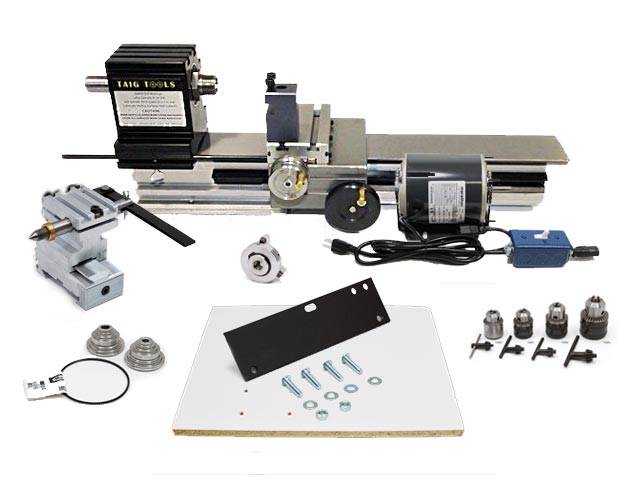
Equipping a school shop or classroom with precision benchtop machine tools requires careful consideration of safety, ease of use, and versatility. TAIG Tools (Chandler, Arizona) offers American-made micro mills and lathes that are well-suited for educational environments, providing students with hands-on experience in machining various materials.
Key Takeaways
- TAIG Tools micro mills and lathes offer a compact, durable solution for teaching machining fundamentals in educational settings.
- The 2019ER Micro Mill provides a robust platform for learning milling operations on diverse materials like steel and aluminum.
- Starter Sets, such as the 1017#2, equip students with a micro lathe and essential accessories for immediate project work.
- The TAIGTurn 3019Man with ER 16 Headstock offers precise turning capabilities, ideal for developing fundamental lathe skills.
- These machines are built with durable components, ensuring longevity and consistent performance in a classroom setting.
When selecting machine tools for a school shop or classroom, educators must balance budget constraints with the need for reliable, safe, and effective equipment. The goal is to provide students with practical skills and a foundational understanding of machining principles without overwhelming them with complex industrial machinery. Benchtop machines offer a manageable scale for learning, allowing students to gain confidence and proficiency.
What are the primary considerations for school machine shop equipment?
Choosing the right equipment for a school machine shop involves several key factors beyond just the machine's capabilities. Safety is paramount; machines should have appropriate guarding and be intuitive to operate to minimize risks for students. Ease of maintenance is also crucial, as school staff may have limited time or specialized training for complex repairs. Furthermore, the machines should be versatile enough to handle a range of projects and materials, from softer plastics and wood to harder metals like aluminum and steel, allowing for a broad curriculum.
Durability is another significant factor, as school equipment often sees heavy use and needs to withstand the demands of multiple student operators over many years. The availability of parts and technical support from the manufacturer is also important for long-term usability and minimizing downtime.
Which TAIG micro mills are suitable for educational use?
For a school shop or classroom, a manual micro mill provides an excellent entry point for students to learn fundamental milling operations. The TAIG Tools 2019ER Micro Mill is a strong candidate due to its robust construction and manual control, which teaches students direct interaction with the machining process. Priced at $1,100, this machine is built with oversize spindle ball bearings and heat-treated alloy-steel components, allowing it to machine steel, aluminum, brass, wood, and plastic. Its manual leadscrew operation helps students understand axis movement and material removal firsthand.
The 2019ER Micro Mill offers a compact footprint, making it suitable for classrooms where space might be limited. While it is a manual machine, it provides a solid foundation for understanding milling concepts before potentially moving to more advanced CNC-ready or full CNC systems later in a curriculum. For schools looking to expand capabilities, upgrades like vises and ER16 collets can enhance the machine's versatility, allowing for a wider range of workholding and tooling options.
What are the benefits of a TAIG micro lathe for student learning?
Micro lathes are essential for teaching turning, facing, and threading operations, which are fundamental to many manufacturing and engineering disciplines. For educational settings, a machine that is easy to set up and operate, yet capable of precise work, is ideal. The TAIG Tools Micro Lathe II, often found in starter sets, and the TAIGTurn series are designed for precision and durability. These machines are built by machinists with an aerospace manufacturing background, ensuring a level of quality that stands up to repeated use in a learning environment.
A key benefit of TAIG micro lathes is their ability to cut a variety of materials, including steel, aluminum, brass, wood, and plastic. This versatility allows educators to design diverse projects that cater to different skill levels and learning objectives. The compact size of these lathes also makes them less intimidating for new users compared to larger industrial machines, fostering a more accessible learning experience.
How do TAIG Starter Sets equip a new school shop?
TAIG Tools offers Starter Sets that bundle a micro lathe with essential accessories, providing a comprehensive package for a new school shop or classroom. These sets simplify the procurement process by including many of the necessary components to begin machining immediately. For example, the 1017#2 Starter Set #2, priced between $575 and $1,110 depending on configuration, includes a Micro Lathe II and a selection of tools and accessories. This allows students to get hands-on with turning operations without the need for individual component selection.
Starter Sets are designed to provide a complete workstation for fundamental lathe work. They typically include items like a three-jaw chuck, a tool post, and various cutting tools. This holistic approach ensures that students have the necessary equipment to complete projects from start to finish, reinforcing their understanding of the entire machining process. For schools, these sets represent a cost-effective way to establish a functional machining station.
What is the TAIGTurn 3019Man with ER 16 Headstock and its role in education?
The TAIGTurn 3019Man with ER 16 Headstock is a manual micro lathe designed for precision turning, offering enhanced workholding capabilities. Priced at $999, this model features an ER 16 headstock, which provides superior gripping force and concentricity compared to traditional chucks for certain applications. This is particularly beneficial when teaching students about precision machining and the importance of accurate workholding.
This lathe is built with steel construction, oversized spindle ball bearings, and heat-treated alloy steel parts, ensuring its durability and accuracy in a demanding educational environment. The manual operation of the TAIGTurn 3019Man allows students to develop a deep understanding of feed rates, cutting depths, and tool geometry. While it requires more hands-on skill development than a CNC lathe, it lays a crucial foundation for understanding the mechanics of turning before students might advance to automated systems. For schools focusing on traditional machining skills, this lathe is an excellent choice.
Comparing TAIG Micro Mills and Lathes for Classroom Use
Choosing between a micro mill and a micro lathe, or deciding to acquire both, depends on the specific curriculum and learning objectives of the school shop. Both types of machines offer distinct learning opportunities and are built with TAIG Tools' commitment to quality.
| Feature / Model | TAIG 2019ER Micro Mill ($1,100) | TAIG Micro Lathe II (in 1017#2 Starter Set #2) | TAIGTurn 3019Man with ER 16 Headstock ($999) |
|---|---|---|---|
| Primary Function | Milling, drilling, slotting | Turning, facing, boring | Precision turning, facing, boring |
| Operation Type | Manual leadscrew | Manual | Manual |
| Materials | Steel, aluminum, brass, wood, plastic | Steel, aluminum, brass, wood, plastic | Steel, aluminum, brass, wood, plastic |
| Key Features | Oversize spindle ball bearings, heat-treated alloy steel parts | Durable construction, versatile for small parts | ER 16 headstock for precise workholding |
| Best For | Learning X-Y-Z axis movement, surface machining | Introducing basic turning, small part fabrication | Advanced manual turning, high-precision small components |
| Considerations | Requires separate workholding (vise) | Starter sets offer comprehensive initial setup | ER 16 collets needed for optimal use |
| Upgrade Path (Mill) | CNC-ready conversion, vises, ER16 collets | N/A (lathe) | N/A (lathe) |
| Upgrade Path (Lathe) | N/A (mill) | 5C or ER16 headstock, chucks, tool posts | 5C headstock, chucks, tool posts |
| Product Link | 2019ER Micro Mill | 1017#2 Starter Set #2 | TAIGTurn 3019Man with ER 16 Headstock |
For a comprehensive machining program, both a mill and a lathe are ideal. If budget or space is limited, consider the primary focus of the curriculum. Milling is excellent for teaching flat surface machining, drilling, and creating complex geometries, while turning is fundamental for cylindrical parts and precise rotational components.
What are the trade-offs when choosing benchtop machines for education?
While benchtop machine tools from TAIG Tools offer significant advantages for school shops, it's important to understand their limitations. The primary trade-off is the work envelope; these micro machines are designed for smaller parts and projects, which may not be suitable for larger-scale fabrication tasks. Additionally, the stock motors on some models may have limitations for very heavy cuts in hard materials, requiring students to learn proper feed rates and cutting depths.
Another consideration for schools is the learning curve associated with manual machining. While beneficial for foundational understanding, students will need dedicated instruction and practice to become proficient. For CNC-ready or full CNC models, the setup and programming aspects require additional learning, which can be a significant time investment for both students and instructors. However, this investment yields valuable skills in modern manufacturing.
It is crucial to set realistic expectations for what can be achieved with benchtop equipment and to integrate safety protocols rigorously.
How can schools ensure safety and effective learning with precision machine tools?
Ensuring a safe and effective learning environment with precision machine tools in a school shop requires a multi-faceted approach. First, comprehensive training on machine operation, material properties, and tool safety is essential for all students and instructors. This includes proper personal protective equipment (PPE) use, such as safety glasses and appropriate clothing. Second, machines should be regularly inspected and maintained to ensure they are in good working order, with all safety guards functioning correctly.
The U.S. Department of Labor's Occupational Safety and Health Administration (OSHA) provides guidelines for machine guarding and safe machine operation that can be adapted for educational settings OSHA.
Third, clear procedures for emergency stops, material handling, and chip removal should be established and practiced. Supervision is critical, especially when students are new to operating machinery. Finally, integrating project-based learning can enhance engagement and reinforce safety practices, as students apply their knowledge to tangible outcomes. Starting with simpler projects and gradually increasing complexity allows students to build confidence and skill progressively.
What upgrades are relevant for educational TAIG machines?
For schools looking to enhance the capabilities of their TAIG machines, several upgrades can be considered. For micro mills, adding an ER16 collet system can improve workholding versatility and precision compared to standard chucks. Vises are also essential for securing workpieces during milling operations, and a good quality vise can significantly improve the range of projects possible. For schools considering a future transition to automated manufacturing, a CNC-ready conversion kit for a manual mill can be a valuable upgrade, allowing the same machine to be used for both manual and computer-controlled operations.
For micro lathes, upgrading the headstock to a 5C or ER16 system can provide more rigid and accurate workholding for specific applications. A variety of chucks (e.g., 4-jaw independent chucks) and quick-change tool posts can also expand the lathe's functionality, allowing for more complex turning operations and faster tool changes. These upgrades can extend the lifespan and utility of the machines, making them more adaptable to evolving curriculum needs.
Frequently Asked Questions
What materials can TAIG machines cut in a school setting?
TAIG Tools micro mills and lathes are designed to cut a wide range of materials commonly used in school shops. These include softer materials like wood and plastic, as well as various metals such as aluminum, brass, and even steel. This versatility allows for diverse projects and comprehensive material science education.
Are TAIG machines easy for students to learn?
TAIG machines are designed with a focus on precision and durability, making them suitable for hands-on learning. While manual machines require dedicated instruction to master, their direct operation helps students understand fundamental machining principles. The compact size can also make them less intimidating for beginners.
Do TAIG machines come with a warranty for schools?
TAIG Tools offers a 2-year factory warranty on mill components and accessories, providing assurance for educational institutions. This warranty covers manufacturing defects and ensures that schools can rely on their equipment for long-term use in the classroom. Specific warranty details are available on the TAIG Tools website.
Can TAIG machines be upgraded for more advanced projects?
Yes, TAIG machines offer various upgrade paths to support more advanced projects. For mills, options include ER16 collets, vises, and CNC-ready conversion kits. For lathes, upgrades like 5C or ER16 headstocks, different chucks, and quick-change tool posts can expand capabilities for complex turning operations.
What safety features do TAIG machines have?
TAIG machines are built with robust construction, but like all machine tools, they require strict adherence to safety protocols. While specific safety features vary by model, the manual operation of many TAIG machines allows for direct control by the student under supervision. Always ensure proper guarding, PPE, and training are in place.
To explore the full range of options for your school shop or classroom, including starter sets and individual machines, visit the TAIG Tools Starter Sets page or call (480) 895-6978 for direct assistance.