
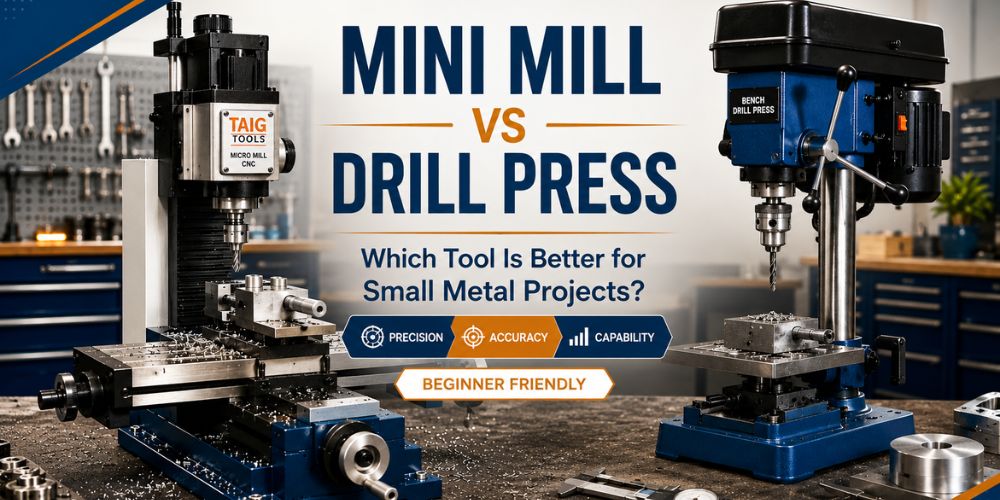
When comparing a drill press vs mill, beginners often wonder which machine is better for small metal projects. Choosing between a milling machine and a drill press comes down to understanding differences in accuracy, cutting capability, and machine movement. This helps determine which tool is best suited for your workshop and long-term projects.
Quick Answer
A mini mill is better than a drill press for precision metalworking because it provides multi-axis movement, greater rigidity, and improved cutting accuracy. Drill presses are mainly designed for vertical hole drilling and light fabrication work.
The comparison below highlights the major differences between a mini mill and a drill press in terms of precision, rigidity, axis movement, and machining capability.
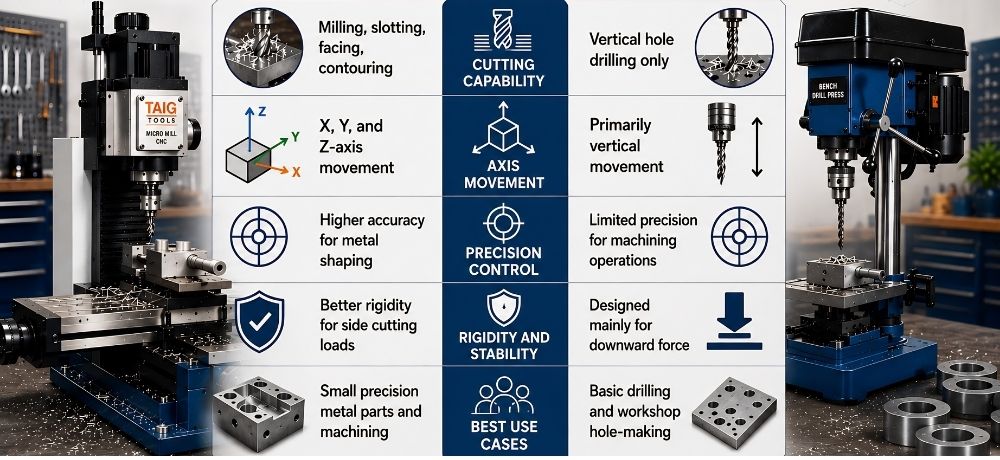
Mini Mill vs Drill Press – Key Differences
When working on small metal projects, understanding the differences between a mini mill and a drill press is essential. While both machines may look similar at first, their capabilities, precision, and rigidity are very different. Choosing the right tool depends on the type of work, materials, and level of accuracy required.
| Feature | Drill Press | Mini Mill |
| Primary Use | Drilling holes | Precision milling and drilling |
| Movement | Vertical only | Multi-axis movement |
| Accuracy | Moderate | High |
| Metal Cutting | Limited | Excellent |
| Precision Work | Not ideal | Ideal |
| Rigidity | Lower | Higher |
| Versatility | Basic operations | Advanced machining |
| Side Load Capability | Poor | Designed for it |
A drill press works well for simple drilling tasks and light workshop projects. A mini mill, however, is better suited for precision metalworking, slotting, shaping, and multi-axis operations, offering higher accuracy, rigidity, and versatility.
What Is a Drill Press?
A drill press is a machine designed primarily for drilling vertical holes into materials such as wood, plastic, and metal. The machine moves the cutting tool straight downward into the workpiece using a rotating drill bit.
A drill press for metal can handle light-duty operations such as:
- Hole drilling
- Countersinking
- Reaming
- Basic shop work
However, drill presses are not designed to handle heavy side loads created during milling operations. Most models lack the rigidity and precision required for accurate metal cutting beyond simple drilling tasks.
Many small workshops use drill presses because they are affordable, compact, and easy to operate for basic fabrication work.
Many workshops use a benchtop drill press for metal drilling, fabrication work, and basic shop operations because it is affordable, compact, and easy to operate. A drill press is commonly used for repetitive hole drilling tasks in home garages, hobby workshops, and light manufacturing environments.
What Is a Mini Mill?
A mini mill is a compact milling machine designed for precise cutting, shaping, drilling, and machining of metal parts using multi-axis movement. Unlike a drill press, a mini milling machine allows the cutting tool or workpiece to move in multiple directions for more complex operations.
Mini mills are commonly used for:
- Precision metal cutting
- Slotting
- Facing
- Contouring
- Prototype machining
- Small part production
Benchtop milling machines are especially popular in small workshops where space is limited, but precision machining is still important.
Many machinists choose compact milling machines because they provide greater accuracy and control while maintaining a manageable workshop footprint.
Drill Press vs Milling Machine: Which One Should You Choose?
When comparing a drill press vs milling machine, the main difference comes down to cutting capability and precision. A drill press is designed for vertical drilling only. A milling machine can cut, shape, slot, and machine metal across multiple axes. Understanding this difference helps you pick the right tool without spending money on capabilities you do not need, or limiting yourself with a machine that cannot grow with your work.
| Feature | Drill Press | Milling Machine |
| Main function | Drilling holes only | Cutting, shaping, and drilling metal |
| Tool movement | Vertical only | Multi-axis (X, Y, Z) |
| Precision | Moderate | High |
| Side cutting | Not designed for it | Built for side loads |
| Work positioning | Basic table, no fine control | XY table with precise handwheels |
| Best for | Basic drilling in wood or metal | Precision machining and metalworking |
Best Uses for a Drill Press:
- Basic hole drilling in metal or wood
- Light fabrication tasks
- Simple workshop operations
Best Uses for a Mini Mill:
- Precision metalworking and prototype parts
- Slot cutting and surface facing
- Contour machining and multi-step operations
Many beginners try to perform milling with a drill press, but this often leads to vibration, poor accuracy, and excessive tool wear because drill presses are not built for multi-directional cutting forces. For long-term metalworking projects, a mini mill provides superior rigidity, better control, and significantly more machining capability.
For small-scale projects and hobbyist workshops, the choice also depends on project size, budget, and workspace.
Mini Mill Advantages for Small Projects:
- Makes small aluminum or steel parts with accurate dimensions
- Good for small prototypes and compact machining
- Provides accurate dimensional control for multi-step operations
Drill Press Advantages for Small Projects:
- Simple holes in metal, wood, or plastic
- Light workshop tasks with minimal setup
- Lower cost and beginner-friendly
While a mini mill offers precision and versatility, a drill press may be sufficient for simple, low-volume projects. Over time, many hobbyists eventually upgrade to a mini mill as their projects become more complex.
Can a Drill Press Be Used as a Milling Machine?
A drill press can technically perform very light milling operations, but it is generally not recommended. Most drill presses are not designed to handle the sideways cutting forces created during milling operations, which is why vibration, chatter, and spindle wear commonly occur when attempting to mill metal with a drill press.
Why Milling With a Drill Press Causes Problems
Milling creates side forces (called radial loads) that act sideways on the spindle. A drill press is only built for downward (axial) force. The moment you try to move a workpiece sideways while the spindle is spinning, you are putting stress on parts that were never engineered for it.
This causes:
- Excessive spindle bearing wear
- Poor surface finish and visible chatter marks
- Tool chatter and vibration
- Reduced accuracy on every pass
- Potential safety issues if the tool grabs the workpiece
Mini mills use stronger bearings, rigid frames, and controlled table movement specifically designed to handle milling forces safely. That structural difference is why a drill press cannot replace a milling machine for serious metalworking.
Can You Use an End Mill in a Drill Press?
Not safely. An end mill is designed to cut sideways as well as straight down. A drill press chuck and spindle are not built for sideways forces. Even light milling passes with an end mill in a drill press can cause:
- The chuck to slip or eject the tool under side pressure
- The spindle bearings are wearing out prematurely
- Vibration that makes clean cuts impossible
- Loss of dimensional accuracy on the part
For any operation involving an end mill, use a milling machine. There is no safe workaround on a standard drill press.
What Is the Difference Between Milling and Drilling?
The primary difference is how the cutting tool removes material.
Drilling
Drilling removes material vertically along the axis of the rotating tool to create holes.
Milling
Milling removes material using both rotational cutting and directional movement across multiple axes. This allows:
- Slots
- Flats
- Contours
- Precision shaping
- Complex geometries
Because milling involves side cutting, it requires significantly more rigidity and control than drilling operations.
Is a Mini Mill Worth It for Beginners?
Yes, especially for users interested in metalworking and precision machining.
A mini mill allows beginners to learn:
- Basic milling operations
- Tool setup
- Precision measurement
- Feed control
- Material removal techniques
Benefits of a mini mill for beginners include:
- Compact size
- Better machining accuracy
- Greater versatility
- Improved project capability
- Ability to machine metal properly
Although the initial investment is higher than that of a drill press, the long-term capability is significantly greater for machining applications.
Those exploring compact machining setups often review different micro milling machine configurations to better understand machine capability, workspace fit, and long-term workshop needs.
When Should You Use a Drill Press Instead of a Milling Machine?
A drill press is still useful in many workshop situations.
Use a drill press when:
- You only need to drill holes
- Precision machining is not required
- The budget is limited
- You mainly work with wood or plastics
- Simple fabrication work is the goal
For occasional drilling operations, a drill press remains a practical and affordable workshop tool. However, for detailed machining and accurate metal cutting, a milling machine is a better investment.
Use a mini mill when:
- You need precision metal parts
- You want to cut slots, contours, or flat surfaces
- You are doing prototype work or multi-axis machining
- You need detailed results on small workshop projects
Small workshop machinists often choose compact mills because they balance precision, footprint, and versatility better than larger industrial machines. Understanding machine size and workshop requirements can also help when choosing the right milling machine size for long-term projects.
Final Verdict: Mini Mill vs Drill Press
For simple drilling tasks, a drill press is affordable and effective. But for precision metalworking, shaping, and accurate machining operations, a mini mill is clearly the superior tool.
Final Recommendation
| Project Type | Better Choice |
| Simple drilling | Drill Press |
| Precision metalworking | Mini Mill |
| Prototype machining | Mini Mill |
| Basic workshop use | Drill Press |
| Multi-axis machining | Mini Mill |
Choosing the right machine depends on your project type, materials, and workshop goals. For users planning long-term metalworking projects, a mini mill offers far greater capability and flexibility.
Explore TAIG Tools’ compact precision milling machines designed for small workshops, prototype machining, and detailed metalworking projects.
FAQs
Should I get a drill press or milling machine?
If your work mainly involves drilling holes in wood, plastic, or light metal, a drill press is usually enough. It is cheaper, simpler, and faster to set up. If you plan to machine metal, cut slots, shape parts, or do any precision work, a milling machine offers far greater versatility, accuracy, and long-term value. Many hobbyists start with a drill press and upgrade to a mini mill once their projects become more complex.
Can you use a milling machine as a drill press?
Yes. A milling machine can drill holes and is often more accurate than a standard drill press for hole placement, because it has a precision XY table that lets you position the workpiece exactly. The only downside is that milling machines are slower to set up for simple repetitive drilling compared to a dedicated drill press.
Can a drill press be used as a milling machine?
It is generally not recommended. Drill presses are not designed to handle the side loads created during milling operations, which can reduce accuracy, cause tool chatter, and damage the machine spindle over time.
What is a mini mill used for?
A mini mill is used for precision metal cutting, shaping, drilling, slotting, and machining small components in compact workshop environments.
Is a mini mill worth it for beginners?
Yes. A mini mill provides better accuracy, versatility, and long-term machining capability for users interested in metalworking and precision projects.
What is a drill press used for?
A drill press is mainly used for drilling accurate vertical holes into materials such as metal, wood, and plastic.
What is the difference between milling and drilling?
Drilling removes material vertically to create holes, while milling removes material in multiple directions for shaping, slotting, and precision cutting.
Which machine is better for metalworking?
A milling machine is better for metalworking because it provides higher rigidity, greater precision, and multi-axis cutting capability. A drill press is better for simple, fast hole drilling where precision machining is not required.
