
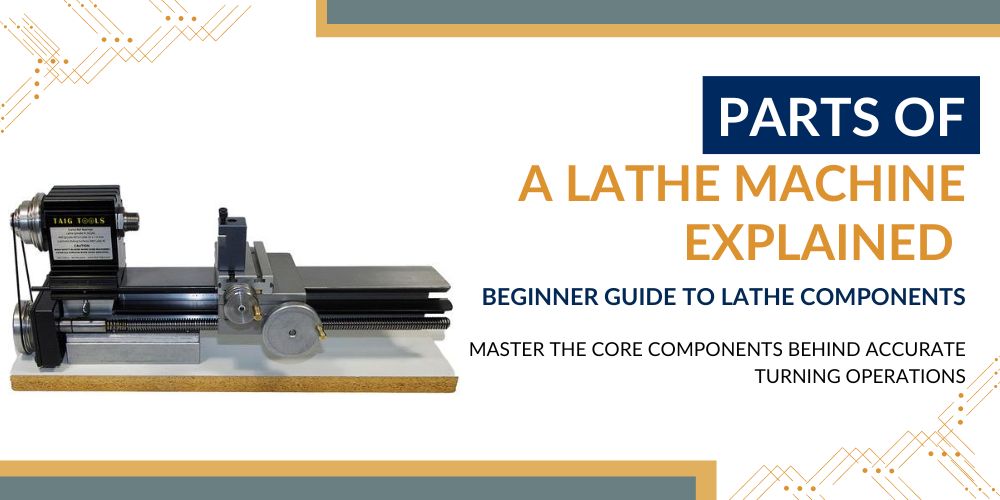
Understanding the parts of a lathe machine and their functions helps beginners learn how turning operations are performed in precision machining. Beginners often search for a lathe parts diagram to understand how the machine works and how each component contributes to accurate cutting.
Every section of a lathe plays a role in controlling movement, supporting the workpiece, and guiding the cutting tool. When machinists understand the main parts of a lathe machine, it becomes easier to perform setup, improve machining accuracy, and operate the equipment safely.
Many new machinists begin learning these concepts while practicing basic turning operations and studying how to use a lathe machine during setup and operation.
Quick Answer: Main Parts of a Lathe Machine
The main parts of a lathe machine include:
- Headstock
- Tailstock
- Carriage
- Cross Slide
- Compound Rest
- Chuck
- Lead Screw
- Bed
These lathe components work together to rotate the material and guide the cutting tool to remove material precisely.
Lathe Machine Diagram With Labeled Parts
Looking for a lathe machine diagram with labeled parts? The diagram below shows the main components including the headstock, carriage, tailstock, and lead screw.
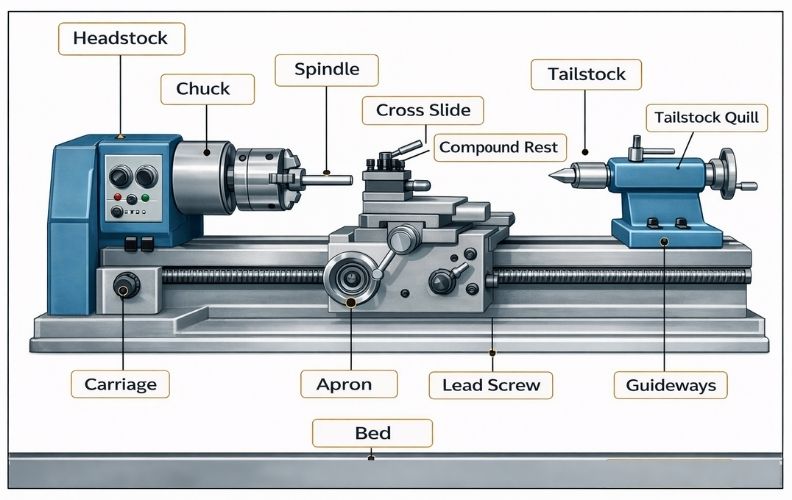
This labeled lathe diagram helps beginners quickly identify each part and understand how the machine works during turning operations.
A labeled lathe machine diagram helps beginners understand how the major components of the machine are arranged and how they work together during machining operations. This type of lathe diagram typically shows important parts such as the headstock, chuck, carriage, cross slide, compound rest, tailstock, and lead screw.
In most lathe parts diagrams, the headstock is positioned on the left side where the spindle rotates the workpiece. The carriage assembly moves along the bed and controls the position of the cutting tool, while the tailstock sits on the opposite end to support long workpieces or hold drilling tools.
By studying a clear lathe machine diagram, beginners can better understand how rotation, tool movement, and support components work together to perform accurate turning operations.
Main Parts of a Lathe Machine and Their Functions
| Lathe Part | Function |
|---|---|
| Headstock | Houses the spindle and powers the rotation of the workpiece |
| Tailstock | Supports long workpieces and holds drilling tools |
| Carriage | Moves the cutting tool along the material |
| Cross Slide | Controls the depth of cut |
| Compound Rest | Allows angled cuts and taper turning |
| Lead Screw | Controls threading operations |
| Chuck | Holds the material securely |
| Bed | Supports and aligns the machine |
This micro lathe assembly video shows how key parts like the headstock, carriage, and tailstock come together in a working setup.
Main Parts of a Lathe Machine
A standard metal lathe includes several critical components that control rotation, movement, and cutting accuracy. These lathe parts work together to produce smooth and precise turning operations.
The most important components include the headstock, tailstock, carriage assembly, lead screw, chuck, and machine bed, which are also commonly discussed when comparing lathe and milling machine parts used in precision machining systems.
Headstock in a Lathe Machine
The lathe headstock is one of the most important components because it drives the entire machining process.
The headstock contains:
- Spindle
- Speed control system
- Drive motor
- Bearings that support rotation
The spindle rotates the workpiece while the cutting tool removes material.
High-quality spindle construction improves stability, which is important for precision turning operations and maintaining consistent machining accuracy.
Regular inspection and lubrication are also important for maintaining spindle accuracy and long machine life.
Tailstock and Its Role in Supporting Workpieces
The lathe tailstock sits opposite the headstock and provides support for longer materials.
It is commonly used for:
- Supporting long workpieces
- Drilling operations
- Reaming holes
- Holding tooling such as drill chucks
Proper alignment between the headstock and tailstock is essential for achieving accurate cuts and preventing tool wear.
Lathe Carriage Assembly Explained
The carriage controls the movement of the cutting tool across the workpiece. This part of the machine directly affects machining accuracy and surface finish.
Cross Slide
The cross slide lathe component moves the cutting tool toward or away from the rotating material. This motion determines the cutting depth.
Compound Rest
The compound rest allows machinists to perform angled cuts and create tapers. It is also used for fine adjustments during precision work.
Tool Post
The tool post holds the cutting tool used to remove material from the workpiece, and choosing the right cutting tool greatly affects finish and accuracy. Choosing the right tool type improves performance when machining different materials.
Selecting the proper cutting tool is important for maintaining clean cuts and consistent results during turning operations.
Lathe Bed and Guideways
The lathe bed forms the foundation of the machine. It supports the headstock, carriage, and tailstock while maintaining precise alignment.
Important functions include:
- Maintaining machine rigidity
- Reducing vibration during cutting
- Keeping components aligned
A rigid machine structure plays a major role in achieving consistent results when machining small metal parts.
This principle is also important in precision machining, where stability directly affects surface quality and accuracy.
Lead Screw and Feed Rod
The lead screw lathe component controls threading operations.
Two systems usually control movement:
- Lead Screw: Used specifically for threading operations where precise synchronization between tool and workpiece is required.
- Feed Rod: Used for standard turning and automatic tool movement during regular machining.
Understanding the difference between these systems helps beginners operate the machine correctly.
Lathe Chuck and Workholding
The lathe chuck secures the material being machined.
Common types include:
- 3 Jaw Chuck: Self-centering and commonly used for round material.
- 4 Jaw Chuck: Allows independent adjustment and higher precision.
- Collet Systems: Often used for smaller precision parts.
Proper workholding is critical for maintaining stability and preventing vibration during machining.
Accessories such as collets and tool holders can expand the capabilities of small lathes used in workshops, and many machinists use specialized accessories to improve workholding stability.
How Lathe Machine Components Work Together
A lathe operates through coordinated movement between several components.
Basic workflow:
- Material is secured in the chuck
- The spindle rotates the workpiece
- The carriage moves the cutting tool
- The cross slide adjusts the cutting depth
- Material is removed to create the final shape
Understanding how these lathe machine components interact helps machinists perform turning operations more efficiently.
Many small part manufacturers rely on this workflow when producing precision components.
Why Understanding Lathe Parts Is Important for Beginners
Learning the parts of a lathe machine improves machining skills and helps operators work more safely.
Key benefits include:
- Better machining accuracy
- Easier troubleshooting
- Improved tool setup
- Safer machine operation
Precision measurement tools are also important when verifying dimensions and maintaining machining consistency, especially for beginners learning practical machining skills with a micro lathe for beginners.
Accurate measurement helps reduce errors and improve repeatability during turning operations, especially when beginners follow a structured lathe machine setup and operation process while learning basic turning techniques.
Choosing a Lathe for Small Workshops
Small workshops often require machines that provide accuracy without taking up excessive space.
When selecting a lathe, consider:
- Machine rigidity
- Spindle quality
- Tool compatibility
- Material capability
Compact precision machines are commonly used in small manufacturing environments, prototyping work, and hobby machining.
Small machines such as micro lathes for small workshops are commonly used for prototyping, small metal parts, and precision machining tasks where compact size and accuracy are important, with machines like the Taig mini lathe are often used in small workshops.
This demonstration shows how a TAIG micro lathe operates in a real workshop environment, highlighting precision and control.
Conclusion
Understanding the parts of a lathe machine is essential for anyone learning turning operations or working with precision machining equipment. Each component plays an important role in controlling movement, maintaining stability, and producing accurate machining results.
When machinists understand how these lathe components work together, it becomes easier to perform proper setup, improve machining quality, and operate equipment safely. Many workshops rely on precision machines for learning, prototyping, and producing detailed metal or plastic components.
Manufacturers such as TAIG Tools design compact equipment that supports accurate machining in small workshop environments.
FAQ
What are the main parts of a lathe machine and their functions?
The main parts of a lathe machine include the headstock, tailstock, carriage, cross slide, compound rest, chuck, lead screw, and bed. Each component plays a specific role in rotating the workpiece and guiding the cutting tool during machining.
What does the headstock do on a lathe?
The headstock contains the spindle, motor, and speed control system that rotates the workpiece during lathe machining operations.
What is the function of the carriage in a lathe?
The carriage moves the cutting tool along the workpiece and controls the cutting process during turning operations.
Why is the lathe bed important?
The lathe bed supports the entire machine structure and keeps the headstock, carriage, and tailstock aligned for accurate and stable machining.
