
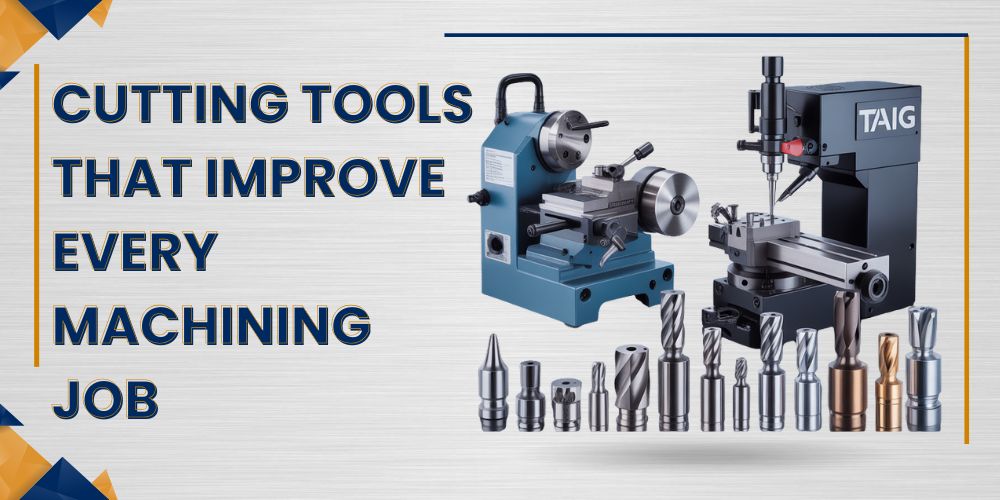
The right cutting tools can make all the difference—they improve machining accuracy, surface finish, and tool life on your TAIG lathe or mill. The right mix of the task and the tool can help you spend less time fixing errors. This way, you can focus more on making parts that match the print.
Understanding Cutting Tools and Machining Operations
Machining removes material from a workpiece to create the final shape. Turning, facing, and boring are common tasks on a lathe, especially when working with small setups like micro lathes.
- Turning means making a smaller diameter.
- Facing means creating a flat end.
- Boring means enlarging a hole.
- Threading is also a common operation.
- On a mill, you cut slots, pockets, and profiles.
The effectiveness of these tools also depends on how well different key components of a lathe machine work together during machining.
When planning a project, consider the chip you want to create. A shallow, continuous chip needs a sharp cutting edge and a steady feed. A heavy interrupted cut needs a stronger edge and perhaps a different insert geometry. Matching the tool to the cut keeps vibration low and accuracy high.
Types of Lathe Tools for Metal and CNC Work
Lathe tools fall into a few broad groups:
- Turning tools trim the outside diameter. A right-hand tool cuts as the carriage moves toward the headstock; a left-hand tool does the opposite.
- Boring bars open or size an internal cylindrical feature. Narrow bores are best done with a small-diameter bar and rigidity with a larger one where there’s space.
- Threading tools cut both external and internal threads. Select a tool that matches the thread form – 60° for Unified and Metric, 55° for Whitworth, and so on.
- Facing a shaft or tube to a flat surface is the initial step before moving to the next step.
On a manual TAIG lathe, you hold HSS or brazed-carbide bits in a four-way or quick-change tool post. You grind the geometry yourself, which allows quick adaptation for one-off parts. A CNC lathe often uses indexable inserts in holders uses indexable inserts in holders, similar to those used on CNC micro milling systems. This lets the machine use multiple tools without manual input.
Insert shape (CNMG, VNMG, etc.) and edge prep decide both chip flow and finish. If you switch a job from manual to CNC, remember that sharper positive-rake inserts use less power. However, they may chip faster on hard metals.
Choosing Milling Cutting Tools for Precision Projects
Your TAIG CNC milling machine or manual mill relies on a handful of tools:
- End mills do most pocketing and contour work, especially on compact micro-milling machines. Two-flute cutters clear aluminum quickly, while four-flute cutters give a better finish in steel.
- Fly cutters skim large, flat surfaces with a single point and produce a uniform pattern when set correctly.
- Slitting saws slice thin sections, useful in many workshop milling setups.
Selecting the Right Cutting Edge Material
Tool material sets the limits for speed, feed, and longevity, especially when machining different CNC milling materials.
| Material | Best For | Typical Speed (SFM) | Notes |
| High-speed steel (HSS) | General shop work, soft steels, brass | 60-120 | Easy to grind, forgiving, lower cost |
| Cobalt HSS | Medium steel, stainless | 70-140 | Hot-hard, resists chipping |
| Carbide | Aluminum, cast iron, hard steel | 200-600 | Runs at high speed, excels in production |
| Coated carbide (TiAlN, AlTiN) | Abrasive or hard materials | 250-800 | The coating keeps heat in the chip and extends its life |
A sharper edge gives a brighter finish, but it is delicate. A honed or radius edge lasts longer but raises the cutting force. For small TAIG spindles, balance edge strength with the horsepower you have. If you cut too wide or feed too much on a large-radius insert, it may stall the motor.
CNC Lathe vs Manual Lathe – Which Tools Work Best?
A CNC lathe keeps tools in repeatable positions so batch parts stay consistent. You can quickly switch between roughing and finishing tools. This lets you use a strong 80° roughing insert with a sharp 35° finisher without changing the setup.
On a manual lathe, flexibility matters more than cycle time. A single HSS blank, ground as needed, can rough, finish, or cut threads. Insert toolholders still help on tough alloys, but the initial cost is higher. Choose the style that matches how often you repeat a part:
- Low volume / wide variety – HSS or brazed carbide you can regrind.
- Medium to high volume – Use indexable holders with positive-rake inserts for steel. Use separate inserts for aluminum to prevent built-up edges
Maintenance and Care for Your Cutting Tools
Even the best cutter fails early if neglected. A short routine keeps tools ready:
- Clean chips and coolant off holders after each use. Dry them to deter rust.
- Inspect the cutting edge under light. If you see a shiny wear land, sharpen HSS bits or rotate carbide inserts.
- Avoid overheating by using the correct speed and feed, something you learn quickly when working with climb and conventional milling. A blue tint on HSS is a sign that the tool has lost its hardness.
- Store tools safely in trays or sleeves. Contact between cutting edges chips them faster than metal removal does.
Sharpening HSS on a fine-grit wheel restores edge quality. Keep relief angles consistent and quench often to hold temper. For carbide, use diamond wheels or send inserts for re-tip if economical.
Final Tips for Better Machining Operation
- Start with the material in mind. A mild-steel job may let you use lower-cost HSS, while a heat-treated alloy might pay back the price of coated carbide.
- Use the shortest, widest holder that clears the work. Extra stick-out amplifies chatter.
- Verify tool data in a speed-and-feed calculator. Most milling cutting tools perform best near the middle of the recommended chip load range.
- On a TAIG spindle, light cuts with a sharp edge often beat heavy cuts that strain bearings.
- Keep records. If an end mill and strategy give a clean surface, save the numbers so you can use the same settings next time.
Selecting tools with these guidelines lets your TAIG lathe or mill reach its true capability. When the cutter, machine, and material work together, you get accurate parts, longer tool life, and smooth finishes. The right tools and setup help your TAIG machine perform at its best.
